
Comparison
ChatGPT vs Setset
Most fashion teams try ChatGPT first when they start looking at AI product photography. ChatGPT is a general creative workspace that generates one image at a time from a prompt, and that is exactly where it runs out of road: holding one look consistent across a whole collection, and producing at the volume a catalogue actually needs.
ChatGPT is genuinely good for exploration, moodboards and a one-off social image. It has no reusable model casting, no batch runs, no garment reference control and no QC pass, which is where catalogue production breaks.
So where does Setset come in? Setset is an AI product photography platform built for fashion and apparel brands, and it is built for the part that breaks. Consistent casting across a full catalogue, garment detail that survives a customer zooming in, brand color that lands on the first pass, and volume runs that arrive organised and ready to publish as finished ecommerce photography.
Setset comes in two versions. Studio is the self-serve workspace your own team produces in. Managed production is where Setset's team produces the catalogue for you.
Setset is model-agnostic: it selects the best frontier model per shot type based on internal evals - including OpenAI's, when they win. The difference is not the model. It is everything wrapped around it.
| ChatGPT | Setset self-serve | Setset managed | |
|---|---|---|---|
| Built for | General creative work, single images, exploration | In-house teams that want to produce their own imagery without adding headcount | Brands producing full collections that want the operation handled |
| Who does the work | Your team, one prompt and one picture at a time | Your team, in the studio, with no prompting | Setset's production team, end to end |
| Input | A written prompt, refined over several turns | Product photo, then pick the model and the look | Product photos, brand guidelines, art direction |
| Model casting | A new face each session, no versioned casting | Curated talent roster, reusable across your runs | Curated roster plus brand-exclusive talent |
| Consistency across a catalogue | NoDrifts between sessions and between shots | YesSame model, look and grade across every run | YesHolds across 1,000 SKUs and beyond |
| Batch production | NoOne conversation per image | YesVolume runs, organised by product | YesHundreds of products in a single run, delivered organised by SKU |
| Shot types | Whatever the prompt describes, stills only | On-model, detail, flat lay, image to video | All of self-serve, plus ghost mannequin, on-location and PDP video at scale |
| Human QC and retouching | NoRe-prompt and hope | Your callYour team reviews and re-runs | YesIncluded - regenerations handled as part of production |
| Cost | $20/mo on Plus, or per-token pricing via the API, plus your team's time | Free to start, then $49/mo individual, $99/mo team | Scoped to your catalogue |
| Delivery | Download from the chat | Organised by product, exported into your stack | Your folder structure, naming and PIM, plus Vault review and approvals |
| Commercial license | You own the output, no model release, C2PA metadata attached | Commercial license on paid plans | Full license in perpetuity, released and brand-exclusive talent |
| Best when | You are exploring an idea or need one image today | Your team wants control and volume without adding headcount | The imagery operation should be somebody else's job |
What can ChatGPT actually do for product photography?
ChatGPT does a real job for fashion teams: it turns a flat lay into a plausible on-model image in a couple of minutes, for $20 a month, with no onboarding. For moodboards, concept tests, a single social post or a pitch mock, that is often the right tool and Setset would not argue otherwise.
The imagery inside ChatGPT now comes from GPT Image 2.5, released 8 September 2026 in two variants: Flare for speed and Sunburst for precision editing. It is a real step up. Latency is roughly halved, two new quality tiers sit above the old ceiling, edits hold better across a conversation, and a new sketch input lets you draw a spatial guide instead of describing one. Studio lighting, clean silhouettes and simple backgrounds are handled well.
What ChatGPT is not built to be is a production system. OpenAI positions it as a general creative workspace, not a catalogue tool, and the product reflects that: no brand kit, no versioned setup, no batch queue, no shot list, no approvals. OpenAI's own image generation docs list consistency for recurring characters as a known limitation.
Which Setset should you compare with ChatGPT?
Compare the self-serve studio. It is a monthly subscription your own team drives, free to start, so it sits in the same budget line and the same workflow shape as a ChatGPT subscription: your team makes the images. The difference is that it is built for garments, casts from a curated talent roster, and holds that casting across every run.
Managed production is the other end of the same platform, for brands that would rather hand the operation over than run it. Both use the same talent roster and the same quality bar, so a team can start self-serve and move volume across without the imagery changing.
The rough dividing line is review capacity, not company size. Once the volume of images somebody has to look at, judge and send back outgrows one person's week, managed production is the cheaper answer even though it is the larger invoice.
Where does ChatGPT break at catalogue scale?
ChatGPT breaks in five predictable places for fashion: repeating textures, logos and trims, countable detail, facial detail, and color grading. Each is survivable on a single image and fatal across a 200 SKU collection, because the errors are different every time and there is no QC layer to catch them.
Texture drift
Fine repeating weaves are the hardest thing to hold. Herringbone, houndstooth, ribbed knit and tweed get re-drawn as an approximation of the pattern rather than the pattern on the actual garment. On a PDP where the customer zooms in, that is a return.
Logos, labels and trims
Embroidered logos, woven labels, hardware and stitching are reconstructed rather than reproduced. Setset handles these with garment reference inputs and a human QC pass, and treats a regeneration as part of production rather than leaving a marketer to re-prompt for an afternoon.
Countable detail
The cleanest test a reader can run in five minutes: give any general model a bracelet with a cluster of nine stones and ask for the product shot. You will get seven. Or eleven. Stating the number in the prompt does not fix it, because the model is drawing something plausible rather than counting something real. Buttons, eyelets, pleats, chain links and studs all behave the same way.
Faces and detail loss
General models lose facial detail as the subject gets smaller in frame, which is exactly the crop most ecommerce grids use, and the reason AI fashion photography so often looks fine in a hero and wrong in a grid. Setset selects the right model per shot type instead of forcing one model to do everything.
Color grading
General models rarely land brand color on the first pass, and grading is the step teams end up fixing manually. Setset grades to the brand's reference set as part of production, so the assets arrive matched rather than close.
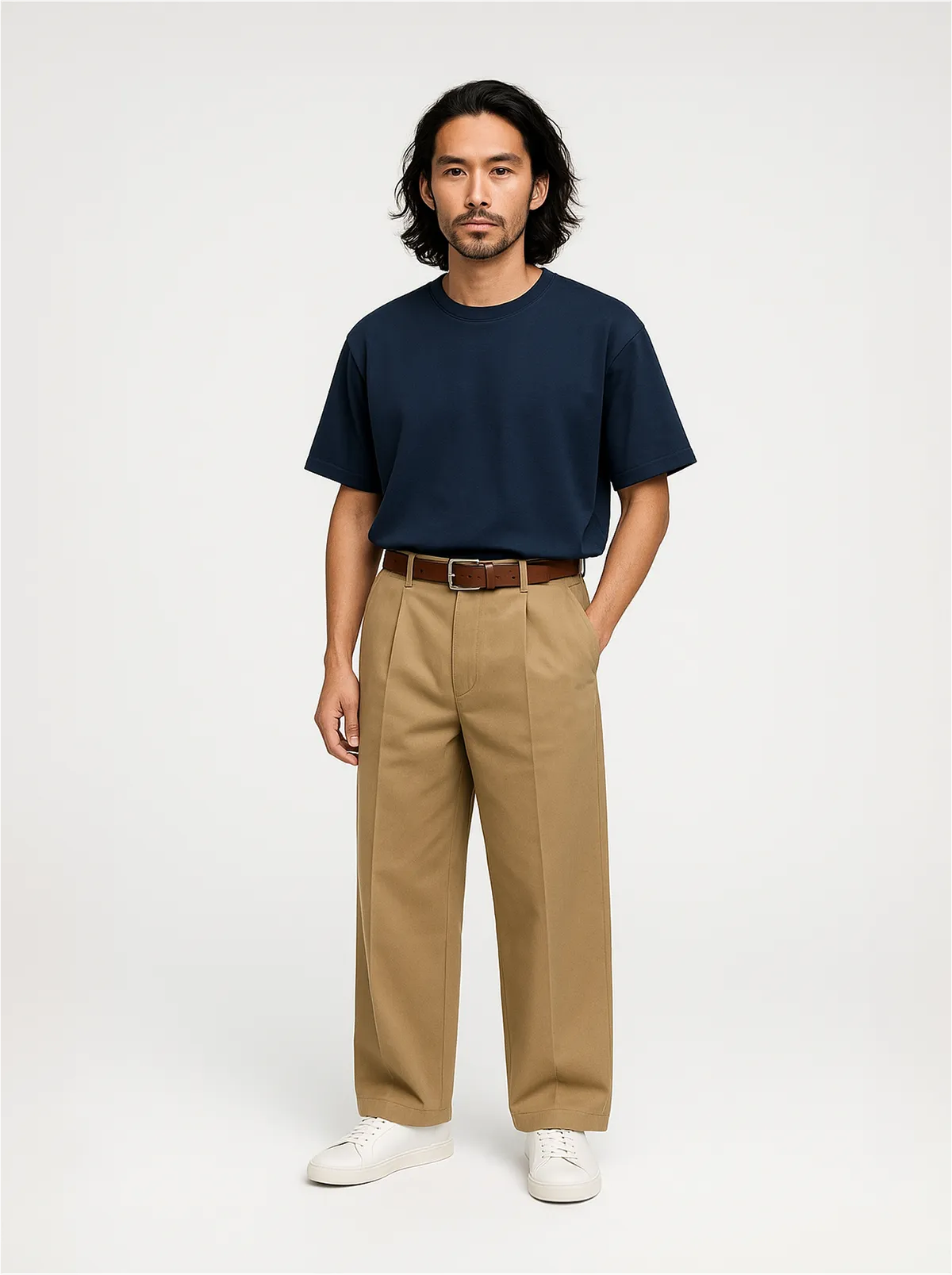
ChatGPTThe trouser front has gained a pleat. The twill reads flat and synthetic, and the navy has shifted deeper than the garment.
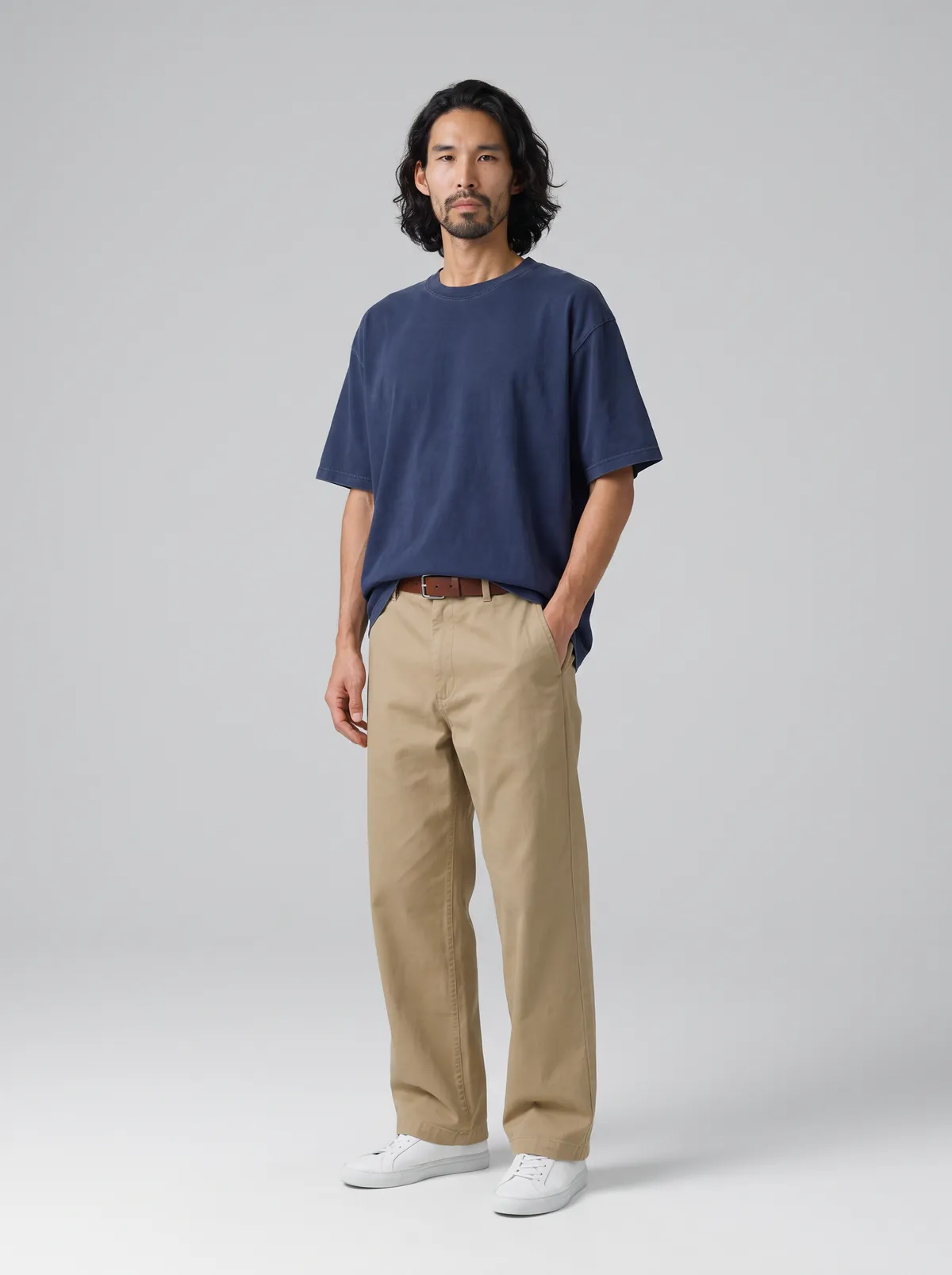
SetsetFlat front, as the garment is made. Natural creasing at the knee, cotton wash intact, colour true to the product.
Can ChatGPT keep the same model across a whole collection?
Not reliably, and OpenAI says so: the Limitations section of its image generation docs notes the model “may occasionally struggle to maintain visual consistency for recurring characters”. A face rebuilt from a reference image shifts across sessions and across shots within a session. Setset casts from a curated talent roster with reusable identities that hold across a full catalogue and across seasons, with brand-exclusive talent available on managed production.
Model consistency is not a nice-to-have on a PDP grid. When six products in a row show six slightly different faces, the grid reads as synthetic and the brand pays for it in trust. This is the single most common reason teams that piloted in ChatGPT move production to Setset.
How much does ChatGPT cost compared to Setset?
ChatGPT Plus is $20 a month, and the GPT Image 2.5 API is priced per token, at the same rates as GPT Image 2. Setset's self-serve studio is a monthly subscription in the same budget line, free to start. Managed production is scoped to the catalogue rather than sold per image, so the honest answer there is a short call.
The real question is whether you can afford ChatGPT-quality output
A generated frame is cheap. An asset that is wrong on your PDP is not. A drifting weave, a redrawn logo, a face that softens at grid crop or a colorway that is nearly right all cost the same thing in the end: a customer who does not trust what they are looking at, and a return that ships back at your expense.
That is the calculation a Creative Director is actually making. Not what does an image cost, but what does it cost when the image is not good enough and it went live anyway. Brands that care about their name tend to find the answer quickly.
And the second cost is your team's time
Teams who have tried it describe the same pattern: somewhere between fifteen minutes and an hour of prompting, re-prompting, cropping and color matching to pull together one final product image. Multiply that by a 200 SKU collection and the subscription price stops being the interesting number.
The frustration compounds too. You tell it not to change the face and it changes the face. You fix the sleeve and it moves the hem. Every session starts from nothing, so nothing you learned last week is still there this week. That is not a prompting skill problem. It is what a chat window is.
Setset prices the finished asset rather than the generated frame, with art direction, options to choose from, human QC and delivery included. Against traditional production, customers spend about 50% less per season, retouch and logistics included, and go from months to days. Brands like TWP, The White Company and Rowing Blazers produce their catalogues this way.
Prompting versus directing: how do the workflows differ?
ChatGPT asks a creative director to become a prompt engineer. Setset asks them to do what they already do: supply styling references, garment detail and art direction, the same inputs a physical studio would receive. Setset's tagline is the whole distinction: stop prompting, start directing.
Close to half the people in buying roles at these brands sit in creative or design. Their input is a reference image and a brief, not a paragraph of model syntax.Setset, 2026 - based on customer conversations
It also matters operationally. Setset delivers into a brand's own folder structure and naming, with Vault for catalogue-scale batch review and approvals, so feedback lands in one place instead of in an email thread. ChatGPT delivers a download.
Is Setset just a wrapper around OpenAI?
No. Setset is model-agnostic: it selects the best frontier model per shot type based on internal evals, then wraps it in garment reference handling, casting, styling control, color grading, human QC and delivery. The model is not the variable. The system around it is.
That system compounds in a way a chat window cannot. Setset does not train its own model, it trains the context it gives the models, per brand, and that context accumulates. By the second and third delivery for a brand, previously produced SKUs resolve first time, because the system already knows how that garment behaves. Approval rates climb between rounds independently of whether the underlying model got better.
It also means model upgrades land as a benefit rather than a rebuild. Competitors who trained a proprietary model in 2024 are locked to a 2024 model. When OpenAI shipped GPT Image 2.5, it went through Setset's evaluation set and into production, and the harness kept working.
What about commercial rights and brand safety?
Under OpenAI's terms you own what you generate, but the output is not guaranteed unique, carries C2PA provenance metadata, and contains a likeness with no model release behind it. Setset self-serve includes a commercial license on paid plans, and managed production delivers a full commercial license in perpetuity with released talent and brand-exclusive model options.
For a DTC social post that distinction rarely bites. For wholesale assets that ship to retail partners, or a campaign that runs in paid media, a released likeness and a clean license chain is what legal will ask for.
There is a brand-safety question underneath the legal one. A general model has no memory of what it produced for anyone else, so nothing stops it from drawing a garment, a pose or a location that sits uncomfortably close to another brand's campaign. Setset handles this as part of art direction rather than leaving it to chance, which is the answer most fashion brands need before AI imagery goes anywhere near a paid placement.
Who should use ChatGPT, self-serve, or managed production?
Use ChatGPT while you are still exploring, Setset Studio once the same look has to hold across a range of products, and managed production once the volume of imagery somebody has to review outgrows one person's week. The dividing line is not company size, it is how much consistency and how much review the work demands.
When ChatGPT is the better fit
Exploration and early concepting, moodboards, a single social image, testing whether an idea has legs before briefing anyone. Small teams shipping a handful of images a month, with no consistency requirement across products, get real value for $20 a month.
When Setset self-serve is the better fit
In-house teams that already tried ChatGPT and hit the wall on consistency and scale. Self-serve keeps the work with your team, adds a curated talent roster, garment fidelity and repeatable looks, and starts free. This is the direct upgrade path from a ChatGPT workflow.
When managed production is the better fit
Brands producing full collections, where the same model, light and grade have to hold across hundreds of SKUs, garment fidelity is checked by a human before delivery, and assets land in your folder structure ready to publish. Setset extends the team you have rather than replacing how you work.
Frequently asked questions
Can you use ChatGPT for ecommerce product photography?+
Yes, for single images. ChatGPT and OpenAI's GPT Image 2.5 produce usable on-model and lifestyle images one at a time, which is why many fashion teams start there. The limits appear at catalogue scale: no reusable model identity, no batch runs, drifting detail between sessions, and no shot list or delivery structure. OpenAI's own image generation docs list consistency for recurring characters as a known limitation.
Does GPT-6 Astra change this for product imagery?+
Not in the way the ads suggest. GPT-6 Astra, released 3 September 2026, is OpenAI's flagship for reasoning and tool use, and it can call an image generation tool, so ask ChatGPT for a product shot and one comes back. Astra is not the renderer though. The picture comes from GPT Image 2.5, in two variants: Flare for speed and Sunburst for precision editing. Astra decides what to ask for. GPT Image draws it.
Is Setset a ChatGPT alternative for fashion brands?+
Yes. Setset is the ChatGPT alternative fashion and apparel brands move to when single images stop being enough: it is purpose-built for AI product photography, with reusable model casting, garment reference control, batch runs and human QC. Setset Studio is the self-serve alternative for in-house teams, and managed production is the alternative for brands that would rather hand the whole imagery operation over.
Is Setset self-serve a ChatGPT alternative for a small team?+
Yes, and it is the closest like-for-like. Setset's self-serve studio is a monthly subscription your own team drives, free to start, so it sits in the same budget line and the same workflow shape as a ChatGPT subscription. The difference is that it is built for garments: it casts from a curated talent roster, holds that casting across every run, and needs no prompting. Managed production is the step after, when review volume outgrows one person.
Is Setset just a wrapper around ChatGPT?+
No. Setset is model-agnostic: it selects the best frontier model per shot type based on internal evals, then wraps it in garment reference handling, a curated talent roster, styling control, color grading, human QC and delivery into a brand's folder structure. The model is not the variable. The system around it is, and because that system is model-agnostic, Setset output improves as the underlying models improve.
How much does ChatGPT cost compared to Setset per image?+
ChatGPT Plus is $20 a month, and OpenAI's GPT Image 2.5 API is priced per token at the same rates as GPT Image 2. Setset's self-serve studio is a monthly subscription in the same budget line, free to start. Managed production is scoped to the catalogue rather than sold per image, so the honest answer is a short call. The number that matters is not the price per generated frame, it is the cost per asset you actually ship.
Why does ChatGPT struggle with fabric texture, logos and countable detail?+
General image models reconstruct a plausible garment rather than reproducing the exact one. Fine repeating weaves such as herringbone, houndstooth and ribbed knit drift, embroidered and printed logos get redrawn, and countable detail is unreliable: ask for a bracelet with nine stones and you will get seven. Setset controls this with garment reference inputs, per-shot model selection and a human QC pass before anything is delivered.
Can ChatGPT keep the same model across a whole collection?+
Not reliably, and OpenAI says so: its image generation docs note the model "may occasionally struggle to maintain visual consistency for recurring characters". A face rebuilt from a reference image shifts across sessions and across shots within a session. For a 200 SKU collection that means visible identity variance on the PDP grid. Setset casts from a curated talent roster with reusable, brand-exclusive identities that hold across a full catalogue and across seasons.
Who owns the commercial rights to ChatGPT images?+
Under OpenAI's terms the user owns the output, but outputs are not guaranteed unique, carry C2PA provenance metadata, and any likeness in them has no model release behind it. Setset self-serve includes a commercial license on paid plans. Managed production delivers a full commercial license in perpetuity, with released talent and brand-exclusive model options, which is the standard wholesale partners and retail platforms expect.
Related comparisons
See how Setset compares to Botika, Kive and Genera, read the full comparison overview, or look up terms like model consistency and ghost mannequin in the AI fashion photography glossary.
Last updated: 13 September 2026